How Can an AI Chatbot Improve Customer Support and Generate Leads?
Admin
Published on October 12, 2026
In today's competitive business environment, customers expect quick responses, personalized communication, and convenient access to information. Whether they are looking for product details, service information, pricing, or appointment availability, a delayed response can affect their experience and influence their purchasing decisions. Managing every inquiry manually can also put pressure on customer support and sales teams.
An AI chatbot for business can help solve these challenges by automating routine conversations, answering frequently asked questions, capturing customer details, and identifying potential sales opportunities. With the right implementation, businesses can provide round-the-clock assistance while allowing employees to focus on complex customer requirements and high-value sales activities.
Neesac.ai offers AI chatbot solutions designed to automate customer support and lead generation across websites and messaging channels such as WhatsApp. By combining natural language processing, knowledge-base-driven responses, lead qualification, and CRM integration, businesses can build a more responsive and efficient customer communication system.
What Is an AI Chatbot for Business?
An AI chatbot is a software solution that interacts with customers through conversational interfaces. It uses technologies such as natural language processing (NLP), machine learning, and AI-powered knowledge retrieval to interpret questions and provide relevant responses.
Unlike a basic rule-based chatbot that follows predefined scripts, an AI-powered chatbot can interpret variations in how people ask questions and use available business information to respond more naturally.
For example, a customer visiting a website might ask:
- What services does your company provide?
- How much does your product cost?
- Can I book an appointment for tomorrow?
- Do you offer support after purchasing?
- How can I speak with your sales team?
An AI chatbot can answer questions using approved business information, collect relevant details, and direct customers to the appropriate next step.
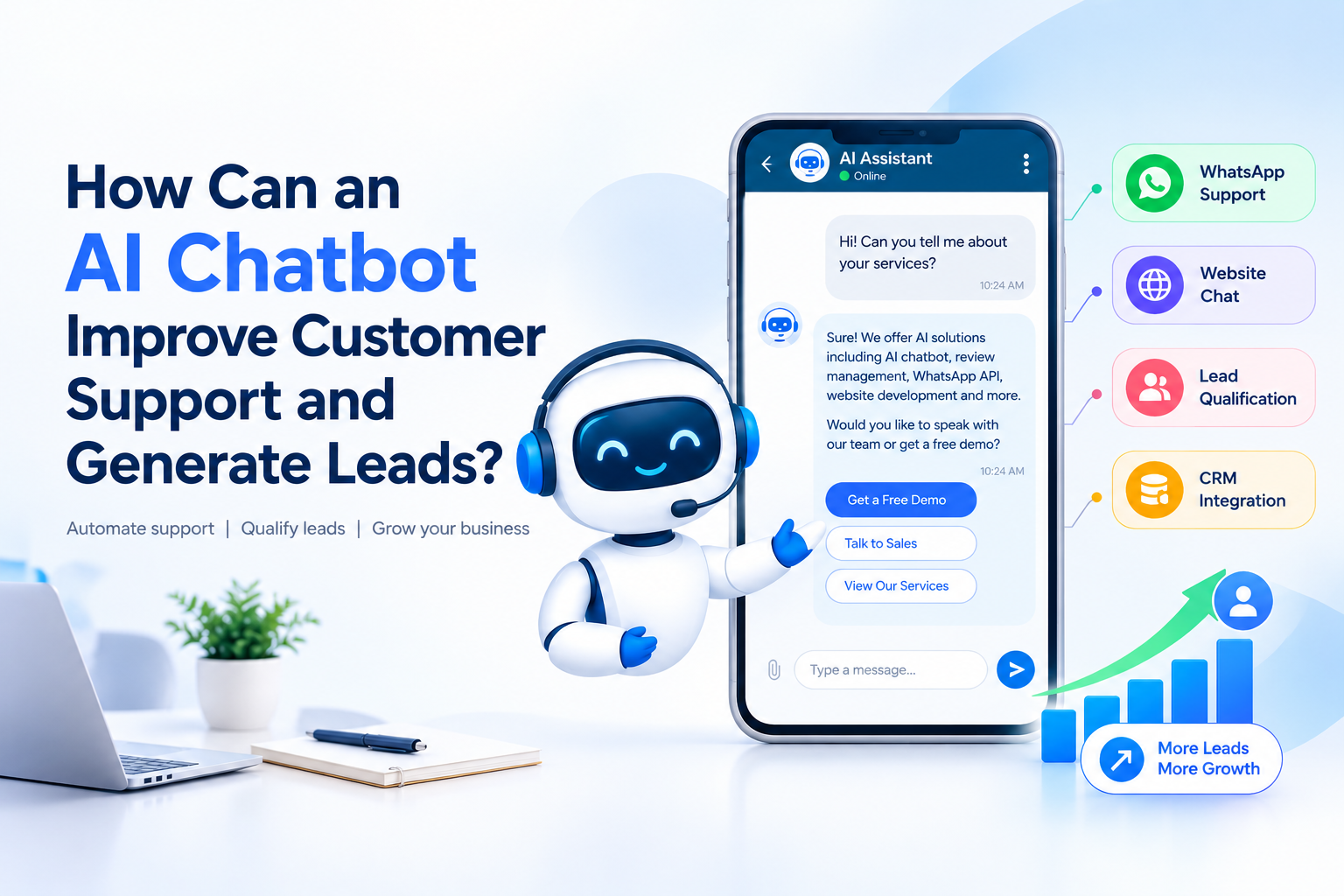
Neesac.ai's AI Chatbot is designed to support customer conversations through websites and WhatsApp, qualify leads, and notify human teams when a query requires additional attention.
How Can an AI Chatbot Improve Customer Support?
1. Provide 24/7 Customer Assistance
Customers may need assistance outside regular business hours. A traditional support team cannot always respond immediately, especially when inquiries arrive overnight, during holidays, or during periods of high demand.
An AI chatbot can answer common questions around the clock, provided the relevant information and integrations are available.
For example, an e-commerce business can use a chatbot to explain product features, share delivery information, answer questions about return policies, and guide customers toward suitable products.
This availability helps businesses provide more consistent support without requiring an employee to handle every routine interaction manually.
2. Deliver Faster Responses to Common Questions
Customers often contact businesses with similar questions about pricing, services, operating hours, product specifications, and appointment procedures.
Handling these inquiries individually can consume considerable staff time.
An AI chatbot can retrieve answers from an approved knowledge base and provide them immediately. Customers receive useful information without waiting for an available representative.
With Neesac.ai, businesses can configure chatbot knowledge around their products, services, and frequently asked questions. When a new or complex question cannot be answered confidently, the workflow can notify the appropriate team for further assistance.
The quality of responses depends on the accuracy of the knowledge base, configuration, and escalation process.
3. Improve Customer Experience Across Multiple Channels
Customers use different channels to communicate with businesses. Some prefer a website chat window, while others are more comfortable using WhatsApp.
Managing these conversations separately can make it difficult to maintain consistent information and follow up on customer requests.
An omnichannel AI chatbot can help businesses provide a more consistent experience across supported channels. Neesac.ai's chatbot offering supports website and WhatsApp conversations, with additional integrations depending on the implementation.
Businesses can use these channels to answer questions, share relevant information, capture inquiries, and guide customers toward sales or support teams.
The objective is to make customer communication easier and more accessible.
4. Maintain Consistent and Helpful Responses
Different employees may explain the same product or service in different ways. This can create confusion, particularly when customers ask about technical specifications, policies, or service conditions.
An AI chatbot can use a shared knowledge base to deliver consistent answers based on approved business information.
For example, a software company can configure its chatbot with product documentation, onboarding instructions, pricing information, and troubleshooting guidance.
This approach helps standardize routine communication. Businesses should still review chatbot answers regularly, update outdated information, and provide a clear option for customers to contact a human representative.
5. Route Complex Queries to Human Support Teams
Not every customer problem should be handled entirely by AI.
Billing disputes, unusual technical issues, sensitive complaints, and requests requiring human judgment may need direct intervention.
A well-designed chatbot should recognize when additional assistance is necessary and transfer the conversation or notify the relevant team.
Neesac.ai's AI Chatbot includes a smart notification and human-handoff approach for complex queries. This helps employees identify conversations that require personal attention.
Combining automated responses with human support creates a practical balance between efficiency and customer care.
How Can an AI Chatbot Generate More Business Leads?
Customer support is only one part of an AI chatbot's value. It can also help businesses turn website visitors and messaging conversations into qualified sales opportunities.
1. Capture Leads While Visitors Are Interested
A potential customer may visit your website, explore a service, and leave without submitting a contact form. A chatbot can provide another way to start a conversation.
For example, a visitor interested in digital marketing services might ask about available packages. The chatbot can explain the services and offer to connect the visitor with the sales team.
With the visitor's consent where required, it can collect relevant information such as:
- Name and business name
- Preferred contact details
- Service or product of interest
- Approximate budget or project requirements
- Preferred time for a consultation
Collecting only necessary information makes the process simpler and helps businesses focus on relevant inquiries.
2. Qualify Leads Through Conversational Questions
Not every inquiry represents an immediate sales opportunity. Sales teams need to understand a prospect's requirements before deciding how to follow up.
An AI chatbot can ask a sequence of relevant questions to identify a potential customer's needs.
For example, a website development company might ask whether the visitor needs a new website, an existing website redesign, an e-commerce store, or a mobile application.
The chatbot can then organize the answers and identify the appropriate service category.
Neesac.ai's AI-powered lead qualification capabilities can support this process by collecting customer information and helping route relevant inquiries to sales teams.
The criteria for a qualified lead should be defined by the business rather than assumed by the chatbot.
3. Book Appointments and Schedule Consultations
Many businesses depend on consultations, demonstrations, or appointments to convert prospects into customers.
An AI chatbot can ask about a visitor's preferred date and time and guide them through the booking process when connected to a supported scheduling system.
For example, a healthcare clinic might use a chatbot to collect appointment preferences, while a software company might use it to arrange a product demonstration.
Actual appointment confirmation should depend on calendar availability and the connected booking system.
By reducing unnecessary back-and-forth communication, businesses can make it easier for interested prospects to take the next step.
4. Connect Lead Information With a CRM
Capturing a lead is only useful when the sales team can access the information and follow up appropriately.
A customer relationship management (CRM) system helps businesses organize contact information, track sales opportunities, and manage follow-up activities.
When connected to a compatible CRM, an AI chatbot can transfer collected lead details, conversation summaries, and customer requirements into the appropriate records.
Neesac.ai's chatbot solution supports CRM-oriented lead workflows, subject to the available integration and configuration.
This can reduce repetitive data entry and help sales representatives understand what a prospect needs before contacting them.
5. Re-engage Interested Customers Responsibly
Some customers need more time before making a purchasing decision. They may compare alternatives, discuss a purchase internally, or return later with additional questions.
A chatbot can explain relevant features, answer follow-up questions, and direct customers to appropriate resources.
Businesses may also use approved messaging workflows to follow up with people who have agreed to receive communications, subject to applicable platform policies and privacy requirements.
Personalized, relevant follow-ups are generally more useful than sending repeated generic promotional messages.
How Does Neesac.ai's AI Chatbot Work?
Neesac.ai's chatbot workflow can be understood through four main stages.
Step 1: Capture Customer Inquiries
A customer starts a conversation through a supported channel, such as a website or WhatsApp.
The chatbot receives the message and interprets the customer's question, language, and apparent intent.
Step 2: Retrieve Relevant Business Information
The chatbot uses its configured knowledge base and conversational context to identify information relevant to the inquiry.
This knowledge base may include product information, service descriptions, frequently asked questions, and approved support instructions.
The usefulness of the response depends on the information available and how accurately it matches the customer's question.
Step 3: Provide a Response or Next Step
The chatbot answers the question, recommends a relevant product or service, collects additional information, or guides the customer toward an appropriate action.
For lead generation, this action might involve requesting contact details or offering a consultation. For customer support, it might involve explaining a process or sharing troubleshooting instructions.
Step 4: Escalate and Improve the Knowledge Base
If the chatbot encounters a question it cannot answer reliably, the configured workflow can alert the human support team.
Employees can review the question, provide the correct information, and update the knowledge base where appropriate.
Over time, this feedback-driven process can improve the quality and coverage of chatbot responses. Businesses should still test changes and monitor performance rather than assume that every interaction automatically produces a correct answer.
Key Features to Look for in an AI Chatbot
When evaluating an AI chatbot for your business, consider the following capabilities.
Natural language understanding: The chatbot should interpret different ways of expressing a question and retrieve relevant information.
Knowledge-base integration: It should use reliable business information and allow teams to update content as products, policies, and services change.
Website and WhatsApp support: Choose channels that match how your customers prefer to communicate.
Lead qualification: The chatbot should collect relevant details and help identify inquiries that deserve sales attention.
CRM integration: Where supported, lead information should move into the systems your team already uses.
Human handoff: Customers should have a clear route to a human representative when automated support is insufficient.
Performance monitoring: Businesses should track response accuracy, unresolved questions, lead quality, escalation rates, and customer feedback.
Neesac.ai's AI Chatbot is designed around several of these capabilities, including conversational support, lead qualification, supported messaging channels, and human-team notifications.
Benefits of Using an AI Chatbot for Business Automation
Implementing an AI chatbot can offer several operational advantages when the solution is properly configured and monitored.
- Reduced repetitive work: Employees spend less time answering the same frequently asked questions.
- Faster customer responses: Routine inquiries can be handled without waiting for an available representative.
- More organized lead collection: Customer requirements and contact details can be gathered through structured conversations.
- Better sales-team preparation: Representatives can receive useful context before contacting a prospect.
- Consistent customer communication: Approved information can be reused across supported channels.
- Scalable support workflows: Automation can help manage increases in routine inquiries without requiring a proportional increase in manual effort.
Actual results depend on inquiry volume, integration quality, the complexity of customer questions, and how well the chatbot is maintained. Businesses should measure results against their own baseline rather than assume a guaranteed reduction in costs or support workload.
Which Industries Can Benefit From AI Chatbots?
E-commerce and Retail
Online stores can answer product questions, explain delivery policies, help shoppers compare options, and route order-related issues to support teams.
Healthcare and Clinics
Clinics can provide general information, explain appointment procedures, and collect booking requests. Sensitive patient information and clinical decisions require appropriate safeguards and qualified human oversight.
Real Estate
Real estate businesses can collect property preferences, understand buyers' budgets, answer general property questions, and route interested prospects to agents.
Education and Training
Educational institutions can respond to questions about courses, admissions procedures, schedules, and enrollment requirements.
IT and SaaS Companies
Software companies can automate basic product FAQs, provide onboarding guidance, direct users to troubleshooting resources, and identify issues that need technical support.
Professional Services
Consultancies, marketing agencies, and service providers can qualify prospects, collect project requirements, and schedule introductory discussions.
Across these industries, the best chatbot workflow is one designed around actual customer questions and business objectives rather than automation for its own sake.
How to Choose the Right AI Chatbot for Your Business
Before implementing a solution, assess your current customer communication process.
First, identify the questions your team answers repeatedly. These are often suitable candidates for automation.
Next, determine which communication channels matter most to your customers. A website chatbot may be sufficient for some businesses, while others may benefit from WhatsApp integration as well.
Review the chatbot's ability to use your existing documentation, connect with your CRM, and notify staff when human assistance is required.
Also consider data privacy, access controls, integration requirements, ongoing maintenance, and the ability to review chatbot performance.
Finally, run a pilot using real-world customer questions. Measure how accurately the chatbot responds, how many conversations require escalation, and whether qualified leads reach your sales team.
Neesac.ai offers an AI Chatbot solution for businesses looking to combine customer support automation with lead qualification across supported digital channels. Reviewing your use cases and integration requirements can help determine whether it fits your needs.
Frequently Asked Questions
1. What is the main purpose of an AI chatbot for business?
An AI chatbot helps businesses answer common customer questions, provide information, collect inquiries, qualify potential leads, and guide customers toward appropriate actions. Its capabilities depend on the configuration and integrations available.
2. Can an AI chatbot generate leads automatically?
Yes. A chatbot can initiate or respond to conversations, ask qualifying questions, collect contact information with appropriate consent, and route relevant prospects to a sales team. Businesses still need an effective follow-up process to convert those leads into customers.
3. Can an AI chatbot work on WhatsApp and a website?
Yes, many business chatbot solutions support website chat and WhatsApp. Neesac.ai's AI Chatbot is designed for these channels, with integration details depending on the selected implementation.
4. How does an AI chatbot improve customer support?
It can provide round-the-clock answers to common questions, reduce waiting time for routine inquiries, deliver consistent information, and direct complex issues to human support representatives.
5. Can an AI chatbot integrate with a CRM?
A compatible chatbot can transfer lead details and conversation information to a CRM, depending on the integration. Businesses should confirm supported systems, available fields, and synchronization requirements before implementation.
6. Is an AI chatbot suitable for small businesses?
Yes. Small businesses can use chatbots to manage routine inquiries, capture leads, and improve response availability without manually handling every conversation. The appropriate solution should match their budget, customer volume, and technical requirements.
7. Does an AI chatbot replace human customer support agents?
Not entirely. Chatbots are useful for repetitive, well-defined tasks, but complex complaints, sensitive issues, and decisions requiring human judgment still need appropriate human involvement.
8. How can businesses measure chatbot performance?
Useful metrics include response accuracy, resolution rate, escalation rate, customer satisfaction, qualified leads captured, appointment bookings, and the time employees spend handling routine inquiries. These metrics provide a more meaningful assessment than automation claims alone.
Conclusion
An AI chatbot can help businesses improve customer support and generate leads by providing faster responses, answering common questions, collecting prospect information, and guiding conversations toward useful outcomes.
When combined with a reliable knowledge base, appropriate human escalation, and compatible CRM integrations, chatbot automation can make customer communication more organized and efficient.
Neesac.ai AI Chatbot is designed to help businesses automate conversations across websites and WhatsApp, qualify potential leads, and notify human teams when additional assistance is needed.
If your business wants to reduce repetitive support work and build a more responsive lead-generation process, explore the available features and integration options to determine how an AI chatbot can fit your workflow.
Ready to automate customer support and lead generation?
Explore the Neesac.ai AI Chatbot and enquire about a solution tailored to your business requirements.